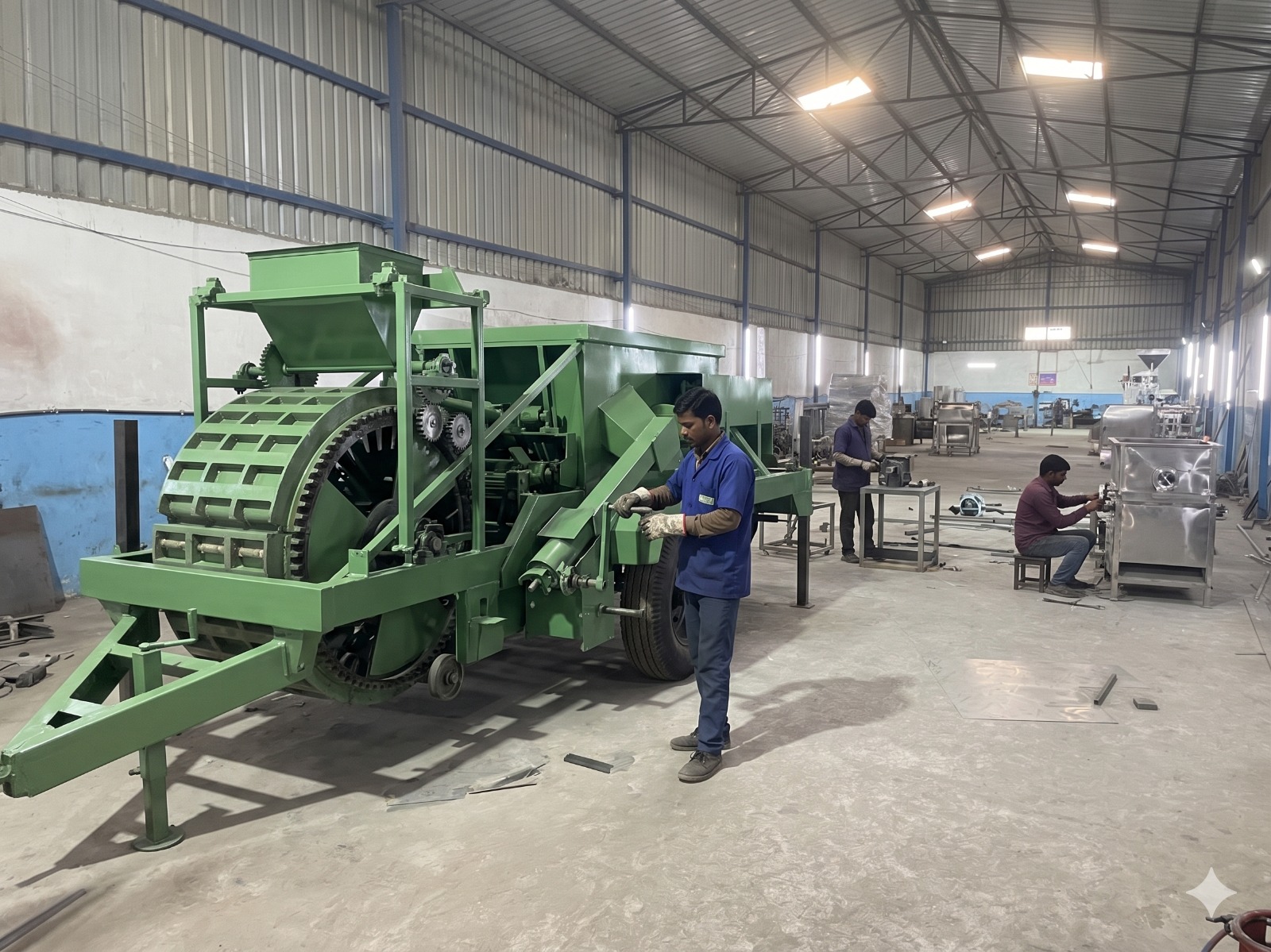


Setting up or upgrading a brick kiln requires more than simply purchasing a brick-making machine. A complete production system may involve clay preparation, brick forming, fuel preparation, airflow management, drying, firing, and material handling.
Choosing the wrong equipment can lead to production bottlenecks, inconsistent brick quality, higher maintenance requirements, and unnecessary operating costs. That is why understanding your production requirements before purchasing brick kiln machinery is essential.
This guide explains the major types of brick plant equipment, what to consider before buying, and how to select machinery that fits your brick manufacturing operation.
What Is Brick Kiln Machinery?
Brick kiln machinery refers to the equipment used across different stages of brick manufacturing, from preparing raw clay to producing and firing finished bricks.
Depending on the type and scale of the plant, the machinery setup may include:
- Soil grinder machines
- Clay mixers
- Pug mills
- Brick-making machines
- Coal crushers
- High draught fans
- Material handling equipment
- Drying and stacking systems
- Kiln-related equipment
Not every brick plant requires the same combination of machines. The right setup depends on factors such as production capacity, brick type, raw material, kiln design, available power, labour, and plant layout.
Why Choosing the Right Brick Plant Equipment Matters
A brick manufacturing plant works as a connected system.
For example, if a brick-making machine can produce more bricks than the drying or firing section can handle, production may become unbalanced.
Similarly, if clay is not properly prepared before forming, increasing machine capacity may not solve the underlying production problem.
Properly selected brick plant equipment can help support:
- Consistent production
- Better raw material preparation
- Efficient material flow
- Reduced avoidable downtime
- Consistent brick dimensions
- Better production planning
- Easier maintenance
- Improved overall plant efficiency
The objective should be to create a balanced production system, rather than simply purchasing the highest-capacity machine available.
Major Types of Brick Kiln Machinery
Before choosing equipment, it is important to understand the role of each major machine.
- Soil Grinder Machine
Raw clay can contain lumps and inconsistent material that may need to be processed before mixing and forming.
A soil grinder machine is used to reduce suitable soil or clay material into a more manageable form.
It can help with:
- Breaking down lumps
- Preparing clay for mixing
- Improving material consistency
- Supporting smoother downstream processing
The appropriate machine depends on the characteristics of the raw material.
- Clay Mixer Machine
After grinding, clay may need to be mixed and conditioned before it reaches the forming stage.
A clay mixer machine helps combine the material and moisture to create a more consistent mixture.
Proper mixing can support:
- Better material consistency
- Improved forming conditions
- More uniform moisture distribution
- Smoother material flow
- Pug Mill Machine
A pug mill is another important piece of equipment used in clay preparation.
A pug mill machine can help mix and condition clay before it moves toward the brick-forming stage.
The exact equipment configuration depends on the production process and the characteristics of the clay being used.
- Brick Making Machine
The brick-making machine forms prepared clay into bricks.
Depending on the production requirements, manufacturers can consider different machine configurations, including:
- Tractor-operated systems
- Electric-operated systems
- Static brick-making machines
- Automatic systems
- Semi-automatic systems
The correct machine should be selected according to the required brick type, production volume, available power, and level of automation.
- Coal Crusher Machine
Where coal is used as a fuel and the kiln system requires prepared coal, a coal crusher machine can help reduce coal to a suitable size.
Proper fuel preparation can support more consistent combustion when matched with the requirements of the kiln.
However, fuel efficiency depends on several factors, including:
- Fuel quality
- Particle size
- Kiln design
- Airflow
- Combustion conditions
- Operating practices
A coal crusher should therefore be selected according to the requirements of the complete fuel and kiln system.
- High Draught Fan
Airflow is an important part of kiln operation.
A high draught fan can be used in applicable brick kiln systems to support airflow and combustion.
Proper airflow can help with:
- Heat movement
- Combustion control
- Temperature distribution
- Smoke and gas movement
- Overall kiln operation
The fan should be selected according to the kiln design and required airflow rather than simply choosing the highest-capacity fan.
- Material Handling Equipment
Material handling is another important part of an efficient brick plant.
The production process involves moving:
Raw Clay → Prepared Clay → Green Bricks → Dried Bricks → Fired Bricks → Finished Stock
Poor material movement can create unnecessary labour requirements and production delays.
When planning a plant, consider:
- Material movement distance
- Worker movement
- Storage areas
- Stacking locations
- Loading and unloading
- Accessibility for maintenance
How to Choose Brick Kiln Machinery
The right machinery should be selected based on your actual production requirements.
Here are the most important factors to consider.
- Determine Your Required Production Capacity
Start by calculating how many bricks you actually need to manufacture.
Consider:
- Daily production target
- Monthly production target
- Number of operating hours
- Number of production shifts
- Expected future expansion
Do not select equipment solely based on its maximum advertised capacity.
The entire plant should be capable of handling the planned production volume.
- Analyze Your Raw Material
Clay characteristics can vary significantly between locations.
Before selecting brick kiln machinery, evaluate:
- Clay type
- Moisture content
- Particle size
- Presence of stones or lumps
- Material consistency
- Processing requirements
Your raw material characteristics can influence the selection of soil grinders, clay mixers, pug mills, and brick-forming equipment.
- Decide the Required Level of Automation
Automation can affect investment, labour requirements, workflow, and plant complexity.
You may consider:
Semi-Automatic Systems
Suitable for operations where manual handling is available and production requirements are moderate.
Automatic Systems
Suitable for plants looking for a higher level of automation and reduced manual intervention.
The right choice depends on your production volume, investment capacity, available labour, and long-term plans.
- Consider Power Requirements
Every machine has specific power requirements.
Before purchasing equipment, check:
- Motor capacity
- Voltage requirements
- Electrical infrastructure
- Power availability
- Generator requirements, if applicable
- Total connected load
The combined power requirement of the entire plant should be considered rather than evaluating each machine separately.
- Check Available Factory Space
Machinery selection should also consider the available space.
A complete brick plant requires space for:
- Raw material storage
- Clay preparation
- Brick forming
- Green brick handling
- Drying
- Kiln operations
- Finished brick storage
- Maintenance
- Vehicle movement
Prepare the plant layout before finalizing machinery.
This can help avoid problems during installation and material movement.
- Evaluate Machine Construction and Components
Brick manufacturing machinery often operates in demanding environments involving clay, dust, vibration, and continuous operation.
When evaluating equipment, consider:
- Machine construction
- Component quality
- Wear parts
- Bearings
- Motors
- Hydraulic components
- Electrical systems
- Safety provisions
- Ease of maintenance
A machine designed for the expected operating conditions can be more practical for long-term use.
- Consider Maintenance Requirements
A machine that is difficult to maintain can result in longer downtime.
Before purchasing, ask:
- Which parts require regular replacement?
- Are spare parts easily available?
- How often does routine maintenance need to be performed?
- Is technical support available?
- How quickly can service be provided?
A good brick machinery manufacturer should be able to provide clear information about maintenance and support.
- Check Spare Parts Availability
Spare parts availability is particularly important for production machinery.
Common wear components may eventually require replacement because of continuous operation.
Before purchasing, understand:
- Availability of replacement parts
- Lead times
- Warranty terms
- Service support
- Installation support
This can help reduce extended downtime when maintenance is required.
- Consider Total Cost of Ownership
Don’t compare machines only on purchase price.
The actual cost of machinery includes:
Initial Cost
Machine + installation + supporting equipment
Operating Cost
Electricity + labour + consumables
Maintenance Cost
Service + spare parts + repairs
Downtime Cost
Production lost because of machine failure
Productivity
Actual usable production achieved
A machine with a lower purchase price may not necessarily have the lowest overall operating cost.
- Choose a Reliable Brick Machinery Manufacturer
The manufacturer is an important part of the purchasing decision.
Before buying, evaluate:
- Manufacturing experience
- Machine specifications
- Previous installations
- Technical support
- Spare parts availability
- Installation assistance
- Warranty
- After-sales service
A reliable brick machinery manufacturer should understand not only the machine itself but also how it fits into the customer’s overall production process.
How Different Machines Work Together
A successful brick manufacturing setup is not based on one machine.
A typical workflow may look like:
Step 1: Raw Clay
↓
Step 2: Soil Grinding
Raw material is processed to reduce suitable lumps and improve consistency.
↓
Step 3: Clay Mixing
Clay and moisture are mixed and conditioned.
↓
Step 4: Pug Mill / Further Conditioning
The material is further prepared according to the production setup.
↓
Step 5: Brick Forming
The prepared clay is converted into green bricks.
↓
Step 6: Drying
Green bricks are dried under suitable conditions.
↓
Step 7: Kiln Firing
Dried bricks are fired under controlled kiln conditions.
↓
Step 8: Cooling & Handling
Fired bricks are cooled, inspected, and moved for storage.
This complete workflow should be considered when selecting brick plant equipment.
How to Avoid Production Bottlenecks
One of the biggest mistakes when setting up a brick plant is focusing on the capacity of only one machine.
For example:
Brick Machine: High production capacity
but
Drying: Lower capacity
or
Kiln: Unable to handle the same production volume
In this situation, the brick machine may produce more green bricks, but overall finished-brick production will still be limited.
Better Approach
Evaluate the capacity of the complete production chain:
Clay Preparation → Forming → Drying → Firing → Handling
The goal should be to maintain a balanced workflow.
Common Mistakes When Buying Brick Kiln Machinery
- Buying Based Only on Price
The cheapest machine may not meet your production or durability requirements.
- Choosing Only by Advertised Capacity
Actual production depends on the complete plant and operating conditions.
- Ignoring Raw Material Testing
Different clay characteristics can require different preparation methods.
- Not Planning the Plant Layout
Poor layout can create unnecessary material movement and handling problems.
- Ignoring Maintenance
Every machine requires appropriate maintenance and inspection.
- Not Checking Spare Parts
Limited spare-parts availability can increase downtime.
- Choosing Equipment Without Considering Future Expansion
If production is expected to grow, the initial plant design should consider future requirements.
- Focusing Only on the Brick-Making Machine
Clay preparation, drying, firing, fuel preparation, airflow, and handling are also important.
Brick Kiln Machinery Buying Checklist
Before finalizing your purchase, review the following checklist:
- Define your daily production target
- Analyze your raw material
- Decide the required automation level
- Check machine capacity
- Check power requirements
- Plan the complete plant layout
- Evaluate machine construction
- Check maintenance requirements
- Confirm spare-parts availability
- Review warranty terms
- Confirm installation support
- Check after-sales service
- Calculate total operating costs
- Consider future production expansion
- Compare suitable manufacturers
Questions to Ask a Brick Machinery Manufacturer
Before placing an order, ask the manufacturer:
Production
- What is the expected production capacity?
- What material conditions are required?
- What brick sizes can the machine produce?
Installation
- What space is required?
- What foundation is needed?
- What electrical infrastructure is required?
Maintenance
- Which parts require regular maintenance?
- Which components are considered wear parts?
- How easily are spare parts available?
Support
- Is installation support provided?
- Is operator training available?
- What after-sales service is provided?
Investment
- What equipment is included?
- What additional equipment will be required?
- What are the installation and commissioning requirements?
Getting clear answers before purchasing can help prevent unexpected costs later.
When Should You Upgrade Your Brick Plant Machinery?
Existing manufacturers may consider upgrading equipment when they experience:
- Frequent machine breakdowns
- Increasing production demand
- Excessive manual handling
- High material wastage
- Inconsistent brick quality
- Production bottlenecks
- Difficulty maintaining existing machinery
- Increasing maintenance requirements
However, an upgrade should begin with identifying the actual production problem.
Sometimes replacing one component or improving a specific process can be more appropriate than replacing the entire production system.
Frequently Asked Questions
What is brick kiln machinery?
Brick kiln machinery includes equipment used across the brick manufacturing process, including clay preparation, brick forming, fuel preparation, airflow management, material handling, and other production operations.
What machinery is required for a brick plant?
The equipment depends on the production process, but a setup may include a soil grinder, clay mixer, pug mill, brick-making machine, coal crusher, high draught fan, and material-handling equipment.
How do I choose the right brick-making machine?
Consider your production target, brick type, raw material, available power, labour, factory space, automation requirements, maintenance needs, and budget.
What should I consider when choosing a brick machinery manufacturer?
Evaluate manufacturing experience, machine specifications, technical support, spare-parts availability, installation assistance, warranty, and after-sales service.
Is an automatic brick plant better than a semi-automatic plant?
The appropriate choice depends on production volume, labour availability, investment capacity, plant layout, and desired automation level. Neither system is universally suitable for every manufacturer.
Why is clay preparation important?
Proper clay preparation can help create more consistent material before the brick-forming stage. Grinding, mixing, and moisture conditioning may be required depending on the raw material.
How can I reduce downtime in a brick plant?
Preventive maintenance, spare-parts availability, operator training, proper machine selection, and regular equipment inspection can help reduce avoidable downtime.
Conclusion
Choosing the right brick kiln machinery is an important decision when establishing or upgrading a brick manufacturing plant.
The focus should not be only on the brick-making machine. A productive plant requires a balanced combination of clay preparation, mixing, brick forming, drying, firing, fuel preparation, airflow, and material handling equipment.
Before purchasing, carefully evaluate your production requirements, raw material, automation level, power availability, plant layout, maintenance needs, spare-parts support, and total cost of ownership.
Working with an experienced brick machinery manufacturer can also help ensure that the selected equipment is appropriate for your production requirements.
The right machinery is not simply the machine with the highest capacity or lowest price—it is the equipment that fits your complete production system and long-term manufacturing goals.